“Architecture should speak of its time and place, but yearn for timelessness.” - Frank Gehry
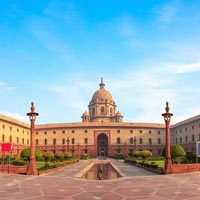
There are no better words to exemplify the grandeur of architectural marvels like Rashtrapati Bhavan, Delhi. This iconic residence attracts visitors from around the world with its timeless architecture and majestic presence.
Rashtrapati Bhavan, the official residence of the President of India, is located in New Delhi. Formerly known as 'Viceroy's House', the mansion was designed by Sir Edwin Landseer Lutyens, a renowned British architect, and assisted by Herbert Baker. Today, it is the second-largest residence of a Head of State in the world, after the Quirinal Palace in Rome.
The construction of Rashtrapati Bhavan began in 1911 when the capital of India was shifted from Calcutta to Delhi. Spanning about 4,000 acres, it required the relocation of Raisina and Malcha villages. Although initially planned for four years, it took 17 years to complete and was renamed Rashtrapati Bhavan in 1950 after India gained independence.
Visitors to Rashtrapati Bhavan can explore historical buildings, lavish Mughal Gardens, museums, and admire the architectural genius of Lutyens that gave rise to the term 'Lutyens' Delhi'. A magical sight is when the Bhavan’s north and south lights synchronize, creating a breathtaking scene.
Main Attractions of Rashtrapati Bhavan:
Mughal Gardens
Influenced by Persian, Mughal, and English gardening styles, these gardens feature a wide variety of flowers. The Mughal Gardens include four parts: Main Garden, Terrace Garden, Purdha Garden, and Butterfly Garden. Open to the public in February, they showcase lotus-shaped fountains, square grids, rose beds, and vibrant creepers, creating a mesmerizing scenery.
Durbar Hall
The central hall, formerly the Throne Room of the Viceroy, is circular with a dome. Yellow Jaisalmer marble columns and Indian marble flooring enhance its grandeur. The hall houses a Gautam Buddha statue from the Gupta era, originally from Calcutta’s Indian Museum.
Gift Museum
This museum exhibits gifts received by Presidents of India, including a 640kg silver chair of King George V from the Delhi Durbar 1911, gold-wired brocade, and paintings by Thomas Daniell and Samuel Havett.
Ashoka Hall
Originally the Viceroy’s ballroom, Ashoka Hall now hosts ceremonial functions. It features a wooden sprung dance floor, vaulted lobbies, chandeliers, and a painted ceiling depicting Persian hunting scenes extended by Italian painter Colonnello, with Indian painters completing the royal procession imagery.
Nearby Attractions
India Gate (2.3 km), Humayun's Tomb (6.7 km), Qutub Minar (11 km), and Siri Fort (12.8 km).
Timing
Rashtrapati Bhavan is open from Friday to Sunday, 9:00 am to 4:00 pm. The Change of Guard ceremony occurs every Saturday at 8:00 am (summer) and 10:00 am (winter). The Mughal Gardens open to the public in February.
How to Reach
New Delhi is well-connected by domestic and international flights. The Central Secretariat Metro station is nearest. Visitors can also hire cabs, taxis, or autos to reach the Bhavan.
Experience the magic of Rashtrapati Bhavan, immerse yourself in India’s rich history, and marvel at the architectural brilliance that defines the nation’s capital.